 how-to
How Fast Roadside Assistance Arrives: UK Response Times
Last Updated: 23 October 2026
Quick Summary
Most breakdown services aim to reach you within 30 to 60 minutes, but how fast roadside assistance arrives depends on your location, the time of day and how you call. Motorway breakdowns typically take 30 to 60 minutes, urban calls 20 to 45 minutes and rural calls up to 90 minutes.
- Motorway jobs take longer because safe access and lane closures add time.
- Rural breakdowns can take up to 90 minutes as the nearest van may be miles away.
- Peak commuting hours push waits to the upper end of the window.
- Give the road name, direction and nearest junction to speed up dispatch.
- Ask the dispatcher for a realistic window and a callback if it slips.
Table of Contents
- How Fast Roadside Assistance Arrives: The Short Answer
- What Affects Your Roadside Assistance Response Time
- Typical Roadside Assistance ETA by Scenario
- Calling for Roadside Assistance: What to Have Ready
- What to Do While Waiting for Breakdown Assistance
- How to Get a More Accurate Arrival Estimate
- Frequently Asked Questions
How Fast Roadside Assistance Arrives: The Short Answer
Most breakdown services aim to reach you within 30 to 60 minutes, but the real answer to how fast roadside assistance arrives depends on where you are, the time of day, and how you call. At SiS Recovery&Breakdown 24/7, we tell drivers the honest version: there is no single number. A city centre call at midday and a hard shoulder call at 2am are two very different jobs.
Roadside assistance response time is the gap between your call and a technician reaching your vehicle. Most providers quote a target window, not a guarantee. Traffic, weather and demand all move that window. Below, we explain what really shapes your wait, give typical scenarios, and show you how to get a tighter estimate.
What Affects Your Roadside Assistance Response Time
Several factors decide your wait, and knowing them helps you set realistic expectations. The biggest is location. A busy urban street is quicker to reach than a remote country lane. Time of day matters just as much. Rush hour and bad weather slow every recovery vehicle.
Here is what moves your roadside assistance ETA up or down:
- Distance to the nearest available technician - the closer the van, the faster you are seen
- Traffic and roadworks - motorway closures can add a long detour
- Weather - ice, fog and heavy rain slow response and raise call volumes
- Type of fault - a flat battery or fuel delivery is quick; a full recovery takes longer
- How clearly you describe your location - vague details waste time
Typical Roadside Assistance ETA by Scenario
Response times vary by setting, so treat any estimate as a guide. A common approach is to ask the dispatcher for a realistic window when you call, not a marketing figure. The table below sums up what to expect across the main scenarios. Similar variables influence auto locksmith arrival times, making it prudent to clarify these expectations before you find yourself stranded.
| Scenario | Typical wait | What drives it |
|---|---|---|
| Motorway breakdown | 30-60 minutes | Safe access and lane closures |
| Urban breakdown | 20-45 minutes | Short distances, but heavy traffic |
| Rural breakdown | 45-90 minutes | Long distances between technicians |
| Out-of-hours | 30-75 minutes | Fewer vans on shift |
| Peak times | 45-90 minutes | High demand and congestion |
Motorway Breakdowns
Motorway jobs need care. A technician cannot simply pull up beside you at speed, so safe access adds time. Expect around 30 to 60 minutes in good conditions. On the M1 and major A-roads, our dispatchers prioritise hard-shoulder calls because the risk to drivers is higher.
Urban and Rural Locations
Town and city breakdowns are often quicker to reach but slower to work around. Traffic can double a short journey. Rural calls stretch the other way: the nearest van may be many miles off. If you are on a quiet B-road, plan for up to 90 minutes and stay safe in your vehicle.
Out-of-Hours and Peak Times
Late-night and early-morning calls can be fast because roads are quiet, but fewer technicians are on shift. Peak commuting hours are the opposite: more vans, but gridlock. If you break down at 8am on a weekday, expect the upper end of the window.
Calling for Roadside Assistance: What to Have Ready
A smooth call gets you seen faster. Before you dial, get these details to hand so the dispatcher can act at once:
- Your exact location, including road number, direction and nearest junction
- Your vehicle make, model and colour
- The registration number
- What went wrong, such as a flat battery, flat tyre or warning light
- Whether you are in a safe spot or stranded in a live lane
According to National Highways guidance on breakdowns, drivers on motorways should get behind the barrier and call for help rather than attempt repairs in a live lane. Clear, calm information helps the call handler send the right vehicle first time.
What to Do While Waiting for Breakdown Assistance
Safety comes before speed. While you wait, move yourself and any passengers to a safe place, away from traffic. On a motorway, that means behind the safety barrier and up the bank. Switch on your hazard lights and, if it is dark, keep a high-visibility jacket handy.
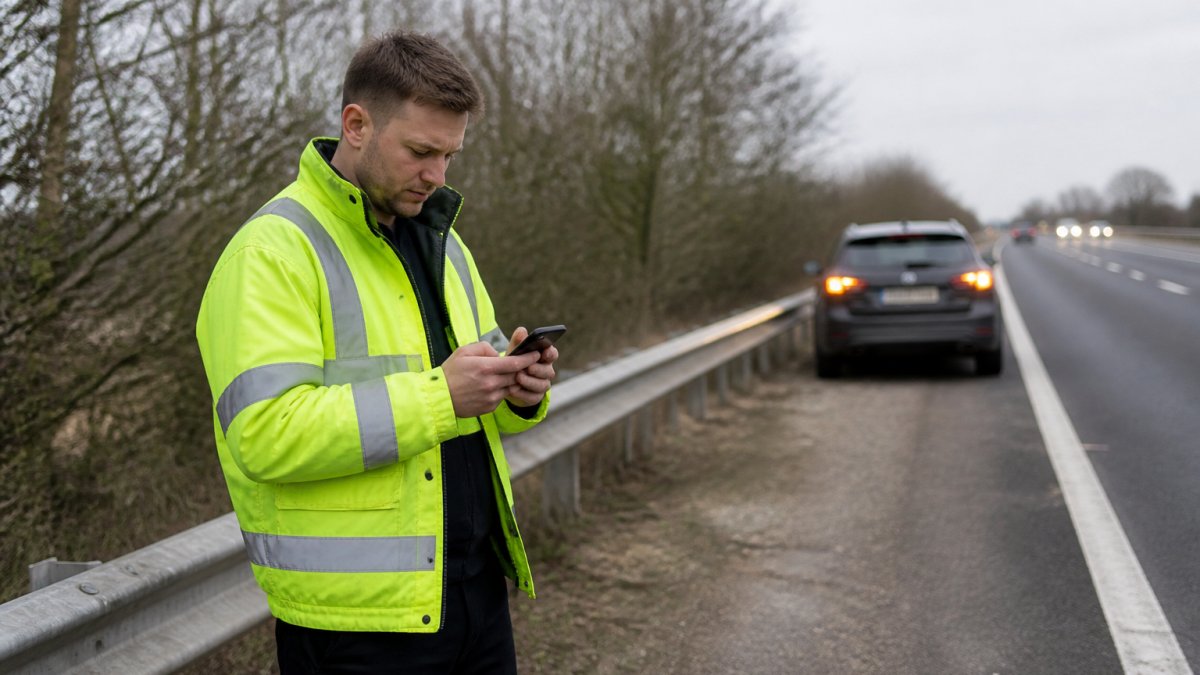
Stay with your vehicle if it is safe to do so, but never stand between your car and moving traffic. Keep warm, keep your phone charged, and note the time you called. Knowing what to do while waiting for breakdown assistance turns a stressful wait into a controlled one.
How to Get a More Accurate Arrival Estimate
You can narrow the window before you even call. The trick is to remove the guesswork the dispatcher would otherwise have to do. A few habits make a real difference:
- Use a location app to share your exact coordinates
- Note the nearest marker post or junction number
- Tell the handler about any access limits, such as a barrier or narrow lane
- Ask for a realistic window and a callback if it slips
- Keep your phone on and answer unknown numbers
When you call SiS Recovery&Breakdown 24/7, our dispatchers give you a straight estimate based on where our nearest van is, not a hopeful figure. We run a 24/7 service, so out-of-hours calls get a real answer, not a voicemail.
Frequently Asked Questions
How long does roadside assistance usually take to arrive?
Most providers aim to reach you within 30 to 60 minutes in urban areas, though motorway call-outs can take longer due to access restrictions. Response times vary by provider, location, and time of day. When you call, ask for an estimated arrival window and note it down. If the provider cannot give a clear ETA, that is often a warning sign. For urgent breakdowns, a dedicated 24/7 service like SiS Recovery typically dispatches immediately.
What can affect roadside assistance response times?
Several factors affect how quickly help arrives: your exact location (motorway hard shoulders and rural roads take longer), traffic conditions, weather, time of day, and how busy the provider is. Motorway breakdowns may require coordination with National Highways traffic officers. If you are on a smart motorway, you may be directed to a refuge area first. Providing clear details, including your junction number, direction of travel, and vehicle type, helps the dispatcher assign the nearest available patrol and gives you a more accurate ETA.
Can I get an estimated arrival time when I call for breakdown help?
Reputable providers will give you an estimated arrival window when you call. Ask for it explicitly: 'What is my estimated arrival time?' Write it down and note the time of your call. If the estimate passes without contact, call back for an update. Some services now offer text updates or tracking links. However, be aware that estimates can shift if the patrol is delayed at a previous job. A provider that refuses to give any estimate is worth avoiding.
What should I do while waiting for roadside assistance?
First, ensure your safety: switch on hazard lights, move to a safe place behind a barrier if possible, and stay away from traffic. Do not stand between your vehicle and oncoming traffic. Keep your seatbelt on if you remain in the car on a hard shoulder. Use the time to gather your documents (driving licence, insurance details, breakdown cover policy number) and take photos of any damage. Stay by your phone in case the patrol calls for directions. If it is dark or cold, keep a blanket and torch accessible. Do not attempt repairs yourself on a live carriageway.
A breakdown is stressful enough without wondering when help will show. If you want a provider that gives you a real ETA and turns up when it says, SiS Recovery&Breakdown 24/7 is built for exactly that. We offer 24/7 emergency availability, immediate dispatch and on-site help like jump starts and fuel delivery, plus safe recovery for cars and vans across the region. Call 07401 271587 and get moving again.